Before paying, check the car, the seller and the original German documents. Then choose a legally valid transport route and complete the RDW, tax and registration steps in the Netherlands.
You can import a used car from Germany, but do not pay until you have confirmed that the seller has authority to sell, the original documents are in order and your transport has been arranged legally. If you drive the car yourself, the Ausfuhrkennzeichen is the relevant export registration; a Kurzzeitkennzeichen is not a standard solution for Germany–Netherlands. The RDW process, taxes and Dutch registration then follow.
Decide before you pay
| Decision | What to check | Consequence |
|---|---|---|
| Is the seller authorised to sell? | Original Teil II and signed proof of purchase identifying the parties, VIN, car, price and handover | Do not pay if the evidence is unclear 1 |
| Is the car’s condition sufficiently known? | HU, maintenance, evidence of damage and pre-purchase inspection | HU is not a complete history 2 |
| Drive it yourself or use a transporter? | Export plate, cover and recognition for the route | Use a transporter if the journey has not been confirmed 3, 4, 5 |
| VAT-new or VAT-used? | First use, mileage and invoice | Determines the special VAT return 6, 7, 8 |
| Which BPM route is permitted? | CO2, first registration, mileage, rate and depreciation | Determines the return and amount 9, 10, 11 |
| Can the German inspection be carried over? | Original report, entry on the registration certificate or sticker | The RDW assesses it; no guarantee 5 |
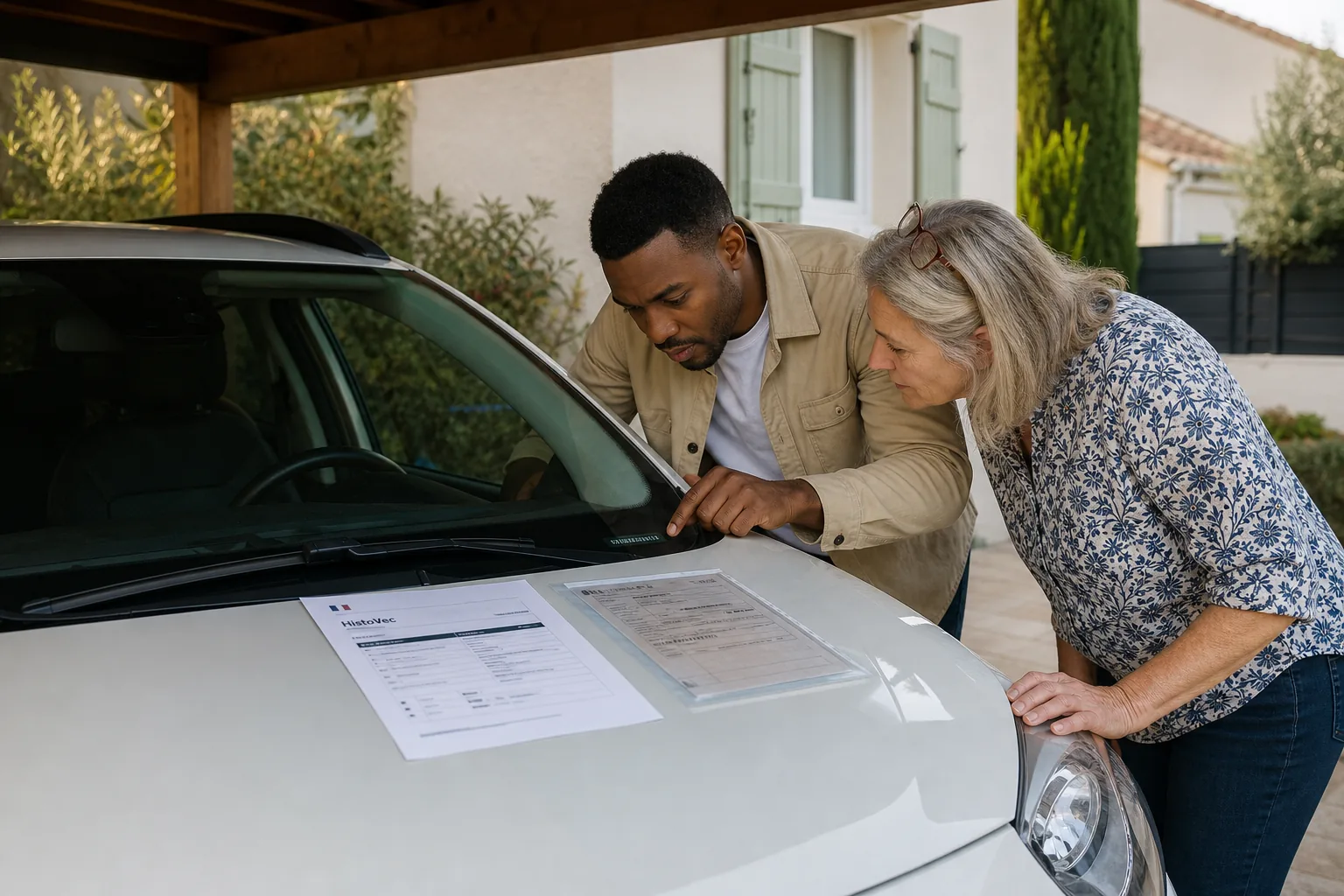
Record the parties, car, price, handover and vehicle identification number (VIN/chassis number) in a signed contract or invoice. The original Zulassungsbescheinigung Teil II proves authority to dispose of the vehicle, not civil-law ownership; the registered keeper and owner may differ in the case of finance or leasing. You should therefore check the seller’s authority to sell the car separately. 1
Compare the VIN on the car and the documents. No official nationwide public database providing a complete German accident, maintenance and mileage history has been identified. A valid Hauptuntersuchung (HU; German periodic roadworthiness inspection) shows only the roadworthiness and environmental condition assessed at that time; damage, general condition and wear require a separate pre-purchase inspection. 2
Arrange German export and transport
| Option | Required | Key limitation |
|---|---|---|
| Drive it yourself with an Ausfuhrkennzeichen | Registration, Teil I, insurance and a suitable HU validity period | Confirm recognition and cover for the entire route 3, 4 |
| Kurzzeitkennzeichen | German test or transfer conditions | No later than the fifth day; Berlin: Germany only, so not a standard cross-border journey 12, 13 |
| Carriage on a vehicle transporter | Quote and collection, delivery and document arrangements | Alternative if the plate, insurance or recognition is uncertain 5, 3 |
| RDW one-day registration | Appointment, printout, white plates, insurance and a safe car | Netherlands only, inspection day and the shortest RDW–home route 14 |
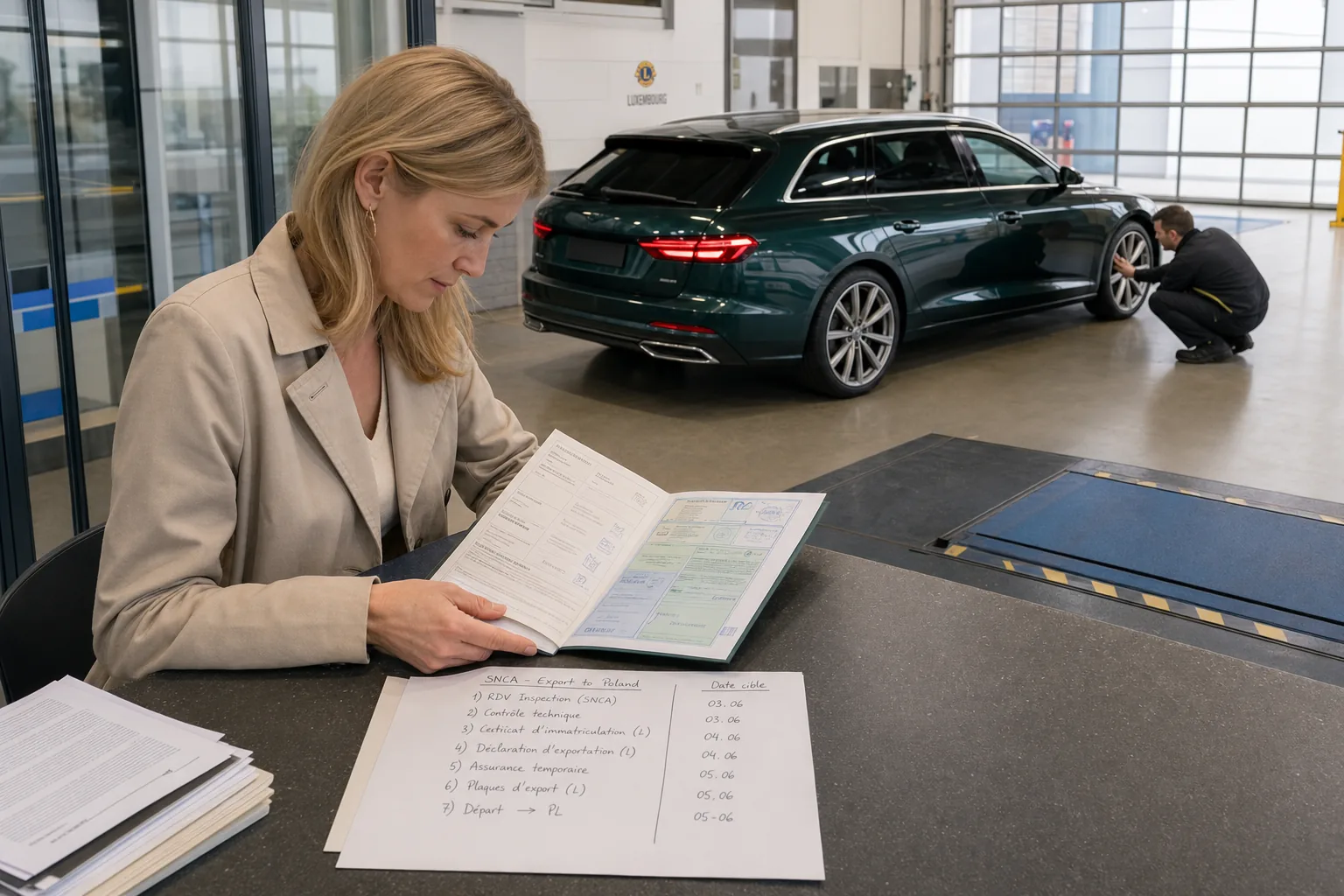
For permanent export, an Ausfuhrkennzeichen requires third-party liability insurance in accordance with the rules for foreign vehicles. The registration period follows the evidenced insurance period, up to a maximum of one year. The next HU due date must fall after the requested expiry date; otherwise, the required inspection must be completed first. 3
When the export registration is issued for a car that is still registered, the old registration certificate and plates are cancelled. The authority takes the old Teil I, records the export allocation in Teil II and issues a new Teil I that must be carried during the journey. Once the period expires, you may no longer use this registration on public roads. This constitutes German deregistration from the existing registration. 3
The competent local Zulassungsbehörde determines the application and presentation requirements. Berlin, for example, may require the vehicle to be presented, original documents and an authorised recipient with the specified German or Berlin connection; this is not a nationwide rule. Confirm the procedure and costs locally. 4
An export plate and insurance do not automatically prove recognition and cover in the Netherlands or transit countries. Confirm both for the exact route; otherwise, choose carriage on a vehicle transporter. The RDW does not issue a registration plate for the journey from Germany. 3 4 5
German motor vehicle tax is payable on the export registration for its period of validity, with a minimum of one month. The Bundesportal route mentions a SEPA mandate and directs non-residents to the authority responsible for the vehicle’s location. Confirm who applies and pays; do not budget for any unconfirmed refund to the seller. 15
Complete the RDW and registration process
Under the EU/EFTA route, a private applicant must be at least 18 and registered in the Dutch Personal Records Database (Basisregistratie Personen). Take valid ID and the complete original foreign registration certificate, and make a copy for BPM in advance. A certificate of conformity (CvO; internationally often CoC) is optional here, but its CO2 value affects BPM. 5
The RDW import inspection identifies the car and assesses its documents; it is not a general technical pre-purchase inspection. Danger or damage can nevertheless result in a prohibition on road use. At the desk, ask for a still-valid German inspection certificate to be assessed: the original report, an entry on the registration certificate or a sticker. Carry-over is not guaranteed. If a car subject to APK has neither accepted evidence nor an RDW APK, arrange the periodic roadworthiness inspection (APK) immediately after receiving the registration certificate; delay may result in a fine. 5
The free RDW one-day registration requires an RDW appointment and is valid only in the Netherlands, on the inspection day and along the shortest route to the RDW and home. You need printed proof, legible white plates, Dutch insurance and a safe car. 14
Keep BPM, VAT and mrb separate
As a private buyer, file a return for private motor vehicle and motorcycle tax (BPM) only after RDW approval and the electronic transfer of data to the Belastingdienst. For BPM, a car that has not been used or has hardly been used is ‘new’; at 3,000 km or more, the car is used in any event, but below 3,000 km it is not automatically new. 9 10
Gross BPM uses the RDW CO2 value. New cars follow WLTP; used cars from before 1 July 2020 follow the applicable NEDC/WLTP branches according to the available measured or converted values, and cars from before 2018 have no WLTP value. If CO2 is unknown, the period ‘1 July 2020 to now’ specifies 550 g/km for petrol or 395 g/km for diesel; for ‘1 January 2015 to 1 July 2020’, the source specifies, if more favourable, 507 g/km for petrol and 356 g/km for diesel; for ‘1 January 2009 to 1 January 2015’, it specifies 350 g/km for petrol and 302 g/km for diesel. 10
For a used car, you may compare permitted current and historic rates and apply depreciation using a Dutch trade price list, the statutory table or a permitted valuation report. You may choose the most favourable permitted depreciation method. A valuation report is permitted only in special cases. The physical valuation must be carried out by an independent recognised valuer within one month before the RDW import inspection, and the car must have no essential defects that prevent lawful road use. Because the official source does not clearly define the AND/OR distinction between the special cases, confirm in advance that your car qualifies for this method. 10 11
For value added tax (VAT), no more than six months since first use OR no more than 6,000 km counts as ‘new’. ‘Used’ requires more than 6,000 km AND supply more than six months after first registration. A VAT-new car from Germany incurs Dutch VAT and requires the private buyer to file the special return for a new EU means of transport. The mere transfer of a VAT-used car does not incur additional Dutch acquisition VAT, but dealer invoice and margin-scheme treatment may differ. 6 7 8
The short-use exception is not the permanent-import rule: a foreign registration plate, the car being made available abroad and advance online notification are required, for no more than two consecutive weeks and once per vehicle and user per 12 months. If the conditions are not met or use continues for longer, BPM and motor vehicle tax (mrb) apply from the first day of use in the Netherlands. 16
After RDW and tax approval, the RDW states that it sends the registration certificate within five working days and the full registration code two working days later, depending on postal delivery. An RDW-recognised manufacturer then makes the plates. From registration in your name, Dutch third-party liability insurance (WA insurance) is required for a car subject to the insurance obligation; the reporting code is the final four digits of the VIN. Registration in your name constitutes the mrb return, after which the bill follows automatically. Call the Belastingdienst if it has not arrived within one month. The amount depends on vehicle type, weight, fuel, environmental characteristics and province. 5 17
Budget without a misleading total
These are separate fees from information checked on 13 September 2026. Do not add alternatives together; without vehicle details, choices and quotes, no total can be calculated.
| Cost item | Amount | Condition |
|---|---|---|
| Purchase price | To be determined | Price and VIN in contract or invoice 1 |
| Pre-purchase inspection | Request a quote | Optional; have it carried out before payment 2 |
| Export registration and German plates | To be determined | Driving yourself; local fee and validity period 3, 4 |
| Export insurance | Request a quote | Driving yourself; duration and territorial cover 3, 4 |
| German motor vehicle tax | To be determined | Export registration; vehicle and duration, at least one month 15 |
| Carriage on a vehicle transporter | Request a quote | Alternative to driving yourself; agree the quote in advance 5, 3 |
| Certificate of conformity (CvO/CoC), translation or exceptional approval | To be determined | Only if the standard route is insufficient 5 |
| RDW vehicle identification | €58.50 | Up to 3,500 kg; fee on 13 September 2026 5 |
| RDW vehicle identification | €120.00 | 3,501 kg and over; fee on 13 September 2026 5 |
| Dutch registration certificate | €50.00 | RDW fee on 13 September 2026 5 |
| Registration in the owner’s name via the RDW | €13.10 | RDW fee on 13 September 2026 5 |
| Recycling contribution | €22.50 | Where applicable, passenger car up to 3,500 kg; 13 September 2026 5 |
| RDW reinspection | €42.00 | Where applicable; fee on 13 September 2026 5 |
| RDW one-day registration | €0.00 | Inspection day only; white plates and insurance are separate; 13 September 2026 14 |
| BPM and any diesel surcharge | To be determined | CO2, first registration, fuel, rate and depreciation 10, 11 |
| Trade price list or permitted valuation | To be determined | Only for the permitted depreciation method chosen 11 |
| Dutch VAT or invoice treatment | To be determined | For VAT-new status or an applicable invoice scheme 6, 7, 8 |
| APK and any repairs | To be determined | If inspection evidence is not carried over or repairs are needed 5 |
| Dutch number plates | Request a quote | After receiving the registration certificate; RDW-recognised manufacturer 5 |
| Dutch third-party liability insurance (WA insurance) | Request a quote | From registration in the owner’s name; request a quote in advance 5 |
| Dutch motor vehicle tax (mrb) | To be determined | Type, weight, fuel, environmental characteristics and province 5, 17 |
| White plates for the RDW inspection day | To be determined | When using the RDW one-day registration 14 |
| Dutch insurance for the RDW inspection day | Request a quote | When using the RDW one-day registration 14 |
Work in chronological order
Keep every item open until you have checked the evidence yourself.
| Action | Evidence | Timing |
|---|---|---|
| Check the seller’s authority | Original Teil II and signed purchase contract or invoice identifying the parties, VIN, car, price and handover | Before payment 1 |
| Compare the VIN and sign the proof of purchase | VIN on the car and documents; parties and price | Before payment 1 |
| Check the condition and history | HU, maintenance, evidence of damage and pre-purchase inspection | Before purchase 2 |
| Collect tax details | First registration, mileage, CO2, fuel and invoice | Before purchase 10, 6, 8 |
| Confirm the export procedure | Requirements and costs of the competent Zulassungsbehörde | Before collection 4, 15 |
| Choose between driving and a transporter | Route recognition and cover, or a quote | Before collection 3, 4, 5 |
| Complete the export registration | Ausfuhrkennzeichen, insurance, Teil I and II | Before the cross-border journey 3 |
| Book the RDW import inspection | Appointment and, if needed, a one-day registration | After arrival 5, 14 |
| Take the originals and BPM copy | ID, complete registration certificate, inspection evidence and, if applicable, CvO/CoC | At the RDW appointment 5 |
| File the tax returns | BPM after the RDW; special VAT return if required | After RDW approval 9, 7 |
| Arrange plates and WA insurance | Registration certificate, code, plates and proof of insurance | From registration in the owner’s name 5 |
| Arrange an APK if needed | Carried-over evidence or a Dutch inspection report | After receiving the registration certificate 5 |
| Check the mrb bill | Assessment or contact with the Belastingdienst | Within one month of registration in the owner’s name 5, 17 |
Frequently asked questions
Can you drive to the Netherlands on a Kurzzeitkennzeichen?
Not as the standard route. It expires no later than the fifth day, and Berlin states that it is for use in Germany only. For permanent export, choose an Ausfuhrkennzeichen, provided that recognition and cover for the route have been confirmed. 3, 12, 13
Which German purchase documents should you check?
Check the complete original registration certificate and the VIN. Have the parties, car, price and handover recorded in a signed document. Teil II shows authority to dispose of the vehicle, but does not in itself prove ownership. 1, 5
Is the RDW import inspection also a pre-purchase inspection or APK?
No. It assesses identity and documents. Separately ask for valid German inspection evidence to be carried over. If there is neither accepted evidence nor an RDW APK, arrange an APK immediately after receiving the registration certificate. 5
When do you file the BPM return?
Only after RDW approval and the electronic transfer of data. At 3,000 km or more, the car is definitely used for BPM; lower mileage does not automatically mean it is new. Do not confuse this with VAT. 9, 10
When is Dutch VAT due?
VAT-new means no more than six months OR no more than 6,000 km; as a private buyer, you then file the special Dutch return. VAT-used requires more than 6,000 km AND supply more than six months after first registration. Invoice rules may differ. 6, 7, 8
Does the RDW one-day registration get you home from Germany?
No. It is valid only in the Netherlands on the inspection day and along the shortest route between the RDW and your home. Print the proof and arrange white plates, Dutch insurance and a safe car. 5, 14
What happens after Dutch approval?
The RDW states five working days for the registration certificate and two additional days for the code, depending on postal delivery. Arrange plates and WA insurance from registration in your name; this also starts mrb. Call if no mrb bill arrives within one month. 5, 17
How much does the entire import cost?
There is no defensible universal total. BPM, VAT, export, transport, inspection, plates, insurance and mrb require vehicle details or quotes. Do not add alternative RDW or transport items together. 5, 14, 10, 17, 15
If you are considering CarAudit in Germany before purchase, first confirm availability at the vehicle’s location. The Dutch site lists Germany, but access to the seller and car, time, weather and a test drive may limit the inspection. The stated 48 hours after inspection, excluding weekends and public holidays, is indicative and dependent on circumstances. This service from Carvago Deutschland GmbH is neither a guarantee against hidden or unobservable defects nor an import administration service. Check the price and the terms effective from 1 August 2026. 18, 19
Sources
- Zulassungsbescheinigung Teil II
- AutoKaufCheck
- Fahrzeug-Zulassungsverordnung (FZV) § 45 Ausfuhrkennzeichen
- Ausfuhrkennzeichen beantragen
- Voertuig invoeren vanuit een Europees land
- Wat zijn nieuwe of bijna nieuwe vervoermiddelen?
- Aankoop van nieuwe en bijna nieuwe vervoermiddelen uit EU-landen
- Auto kopen of verkopen: btw
- Ik koop een motorrijtuig in het buitenland - hoe zit het met de bpm-aangifte?
- Hoe bereken ik de bpm voor een personenauto?
- Bpm afschrijving gebruikte motorrijtuigen
- Fahrzeug-Zulassungsverordnung (FZV) § 42 Kurzzeitkennzeichen
- Kurzzeitkennzeichen beantragen
- Eendagskenteken aanvragen
- Ausfuhrkennzeichen beantragen
- Vrijstelling bpm en mrb bij kortstondig gebruik
- Motorrijtuigenbelasting
- CarAudit: koop een tweedehands auto nooit blind
- CarAudit-voorwaarden